
5 Love Languages Test: Complete Guide to Understanding and Using Them
Take 5 Love Languages Test Online
Get StartedWhat Are the 5 Languages of Love?
Relationships thrive when affection is translated into signals the other person truly hears. This practical framework explains why one person lights up at heartfelt words while another warms to a helpful chore. Instead of guessing, you can decode patterns, find clearer ways to express care, and reduce avoidable friction. When partners share a common map, everyday moments become opportunities to connect deliberately.
At its core, the model outlines five distinct channels through which people prefer to give and receive affection. In many guides, you will see the phrase 5 love languages used to summarize these channels clearly. The concept gained global attention through the work credited to 5 love languages gary chapman, whose accessible writing popularized the idea. When people talk casually, they might say a partner has a primary 5 love language, meaning one channel matters a bit more than the others.
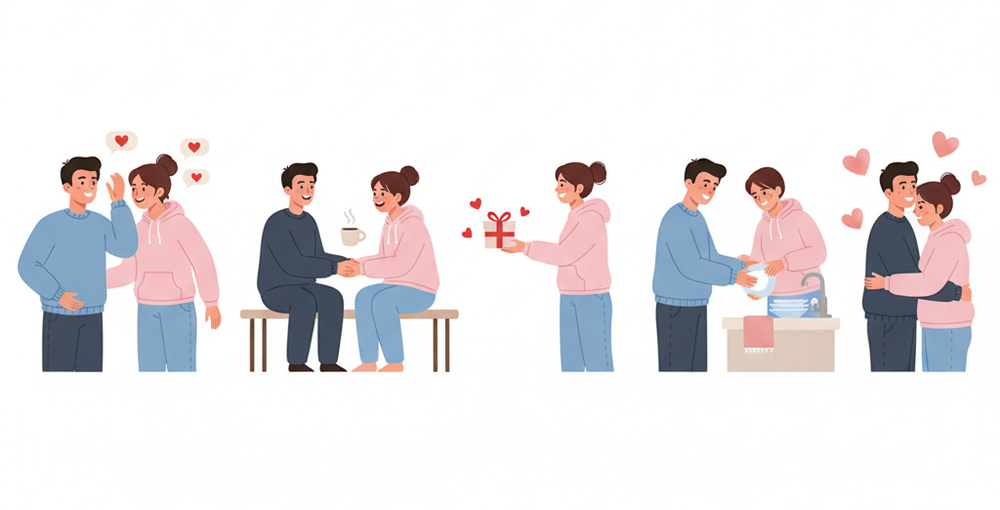
- Words of affirmation validate identity and effort with simple, sincere messages.
- Acts of service turn love into visible help that lightens mental and physical load.
- Receiving gifts celebrates thoughtfulness rather than price tags or grand gestures.
- Quality time builds closeness through shared attention and unhurried presence.
- Touch, when welcomed, calms, anchors, and fosters a sense of belonging.
Because the framework is descriptive rather than prescriptive, it invites curiosity instead of rigid rules. You do not need to guess perfectly from the start, because small experiments reveal what lands best. Over time, a shared language emerges, and your unique relationship customs become reliable, caring routines.
Benefits and Real-World Applications
The framework becomes practical once you translate it into daily habits. Clarifying preferences reduces misunderstandings before they can harden into resentment. Even small adjustments, such as a note in a lunchbox or setting a recurring check‑in, can magnify trust. The real benefit is not perfection, but responsiveness that shows you are paying attention.
For some partners, a hug at the door explains more than any paragraph of text. In that context, the term 5 love languages physical touch highlights how proximity and warmth can soothe nervous systems. Couples that prefer planning may lean toward shared rituals like weekly walks, game nights, or cooking together. When conflict arises, insight into styles gives you a playbook for repair attempts that feel sincere. Many pairs also confirm progress by using a structured tool such as the 5 love languages test couples, which can spark constructive conversations.
Parents often see the framework come alive at home during everyday routines. To tailor your approach for children, consider guidance connected to 5 love languages for kids, so affection lands in ways that match a child’s temperament. You might combine breakfast chats, bedtime stories, and chore charts with specific appreciation statements. Over weeks, you will notice smoother transitions, fewer power struggles, and more spontaneous cooperation.
- Reduce friction by speaking to the preference your loved one recognizes fastest.
- Build resilience by spreading care across multiple channels when stress rises.
- Measure progress with small, repeatable rituals tied to what matters most.
- Repair faster by offering apologies and gestures in the recipient’s preferred style.
How to Discover Your Primary Language
Discovery works best when you mix reflection with low‑stakes experiments. Notice what you request most, what you complain about most, and what you instinctively do for others. Ask yourself which gestures feel energizing versus merely nice, and track patterns over a few weeks. Then compare observations with your partner’s perspective to reduce blind spots.
Some people like starting with a guided evaluation because it reduces guesswork. For that, a straightforward option is the 5 love languages test, which can point you toward a likely preference profile. Use results as a hypothesis, not a label, and let real life inputs confirm or refine the picture. Treat differences as information that helps you adapt rather than as evidence of incompatibility.
| Language | Key signals | Common misreads | Starter ideas |
|---|---|---|---|
| Words of affirmation | Lights up at praise, remembers exact phrases | Silence mistaken for disapproval | Specific compliments, voice notes, gratitude journals |
| Acts of service | Relaxes when tasks are shared or completed | Help seen as control if not discussed | Prep meals, run errands, handle recurring chores |
| Receiving gifts | Values symbols of thoughtfulness and timing | Assumed materialism or extravagance | Meaningful mementos, notes with small surprises |
| Quality time | Seeks undivided attention and shared focus | Multi‑tasking read as disinterest | Tech‑free walks, coffee dates, weekly retrospectives |
| Touch | Reassured by closeness and gentle contact | Affection overlooked during busy periods | Lingering hugs, hand‑holding, cozy movie nights |
Exploration is smoother when you keep the process playful. You might compare impressions after trying sample activities for each style over a few days. If you prefer formal prompts, a concise tool like a 5 love language test can complement journaling and conversation. However you begin, focus on what consistently deepens ease, warmth, and mutual understanding.
Practical Tips for Couples, Singles, Parents, and Teens
Effective communication starts with clarity, so pick one small habit to practice daily. If you lean toward words, write a sentence that highlights a specific effort your loved one made. If you prefer service, take initiative on a task you can complete without prompting. When you lean toward time, schedule micro‑moments of connection and protect them like important meetings.
Those exploring connection outside a committed relationship can still use these insights. A brief self‑check similar to the 5 love languages test singles helps you notice how you naturally express appreciation on dates. You can communicate preferences early by describing what makes you feel seen, without turning the moment into an interview. Keep it light, offer examples, and pay attention to how the other person responds.
Adolescents benefit from explicit guidance and simple routines that fit their schedules. Many families introduce a youth‑friendly quiz like the 5 love languages test for teens to prompt a short conversation after dinner. Schools and mentors sometimes adapt reflections aligned with the phrase 5 love languages test teens to support social‑emotional learning. Encourage teens to pick a weekly action, try it with a friend or sibling, and then reflect on what changed.
- Create shared rituals tied to the style that feels most nourishing for each person.
- Use calendars, reminders, and checklists to keep promises visible and reliable.
- During conflict, pause, name needs clearly, and offer a repair in the other person’s style.
- Rotate through the five channels in small ways to keep connection fresh and flexible.
FAQ: Common Questions About the Languages of Love
Do these preferences stay the same, or do they shift over time?
They can absolutely shift as circumstances and stress levels change. Life stages, job demands, and health all influence what feels nourishing. Keep revisiting the conversation, because periodic check‑ins prevent stale assumptions. A flexible mindset ensures your gestures keep matching real needs rather than old patterns.
How can I identify my partner’s style without using a quiz?
Start by observing what they request, what disappoints them, and what they naturally offer to you. If you want prompts without a formal test, a resource like a 5 love languages questionnaire can guide gentle reflection. Ask open questions, share your guesses, and invite correction with curiosity. The goal is collaborative discovery, not a verdict.
Can this framework improve friendships and family dynamics too?
Yes, because the core idea is about tailoring care to the receiver. Friends and relatives often respond strongly to small, predictable gestures that match their preferences. You can start with brief experiments, then adopt the ones that consistently create ease. Over time, your relationships gain stability, warmth, and fewer misunderstandings.
What if my partner and I prefer different styles?
Differences are normal, and they do not predict distance when handled well. Agree on a few anchor habits in each person’s preferred channel, then trade small favors during stressful weeks. When time is tight, prioritize the top one or two gestures that have the biggest payoff. Mutual accommodation builds a virtuous cycle of goodwill.
How do we start small without feeling overwhelmed?
Pick one micro‑habit per person and practice it for two weeks before adding another. Keep actions tiny, like a daily note, a thirty‑second hug, or a ten‑minute walk. Track wins aloud to reinforce momentum and celebrate progress. When that becomes easy, expand gradually and refine based on feedback.